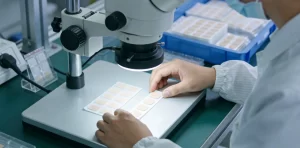



As an Amazon seller, judging the quality of glue used by a bandage factory is a critical part of product sourcing and factory auditing. Glue quality directly determines a product’s adhesion stability, skin friendliness, and customer reviews, which in turn impacts your Amazon rating and return rate.
Based on the latest industry testing standards and national standards , we have compiled a comprehensive evaluation system covering physical properties, chemical safety, biocompatibility, and sensory judgment.
Core Physical Property Indicators – Directly Impact User Experience
The most intuitive reflection of glue quality is adhesion. If adhesion is insufficient, the bandage falls off easily; if it’s too strong, removal causes pain or even skin damage. Here are the key indicators for measuring glue quality:
1. Peel Strength – The Most Important Quantitative Indicator
According to the national standard YY/T 0148-2006 General Requirements for Medical Tapes, the 180° peel strength of bandages should be between 1.0 and 3.0 N/cm.
| Glue Quality | Peel Strength Range | User Experience |
|---|---|---|
| High Quality | 1.0 – 3.0 N/cm | Firm adhesion, painless removal, no residue |
| Low Quality (Weak Adhesion) | < 1.0 N/cm | Falls off easily, fails to protect wound |
| Low Quality (Too Strong) | > 3.0 N/cm | Painful removal, may damage skin or leave adhesive residue |
2. Holding Power
Measures the adhesive’s ability to maintain adhesion over time. High-quality glue maintains position without lifting or shifting under simulated body temperature (36°C-38°C). The test measures displacement time under a standard load.
3. Initial Tack
Tested using the rolling ball method – measuring how far a standard steel ball rolls on an inclined adhesive surface. High-quality glue provides moderate initial tack for quick fixation while allowing repositioning.
4. Aging Resistance
Accelerated aging tests (high temperature/high humidity) simulate long-term storage performance. Low-quality glue may show:
- Adhesive hardening: Loss of tack
- Adhesive migration: Penetration into backing material
- Yellowing: Oxidation degradation
Chemical Safety Indicators – The Compliance Bottom Line
The chemical composition of glue directly affects whether your product passes Amazon’s compliance review and whether it causes consumer allergies.
1. Heavy Metal Content
High-quality medical glue strictly controls residues of lead, cadmium, mercury, and other harmful heavy metals. Testing via atomic absorption spectroscopy ensures compliance with medical standards.
2. Fluorescent Substances
Some low-quality factories add fluorescent whitening agents to glue or backing materials for a whiter appearance. This is a major taboo for medical dressings and may cause skin allergies. UV light can quickly screen for this.
3. Ethylene Oxide (EO) Residue
If bandages are sterilized with ethylene oxide (EO), the glue may absorb EO residues. National standards require EO residue ≤ 10μg/g. Excess levels cause skin irritation.
4. pH Value
Glue should be close to the skin’s slightly acidic environment (pH 5.5-7.0), avoiding alkaline or strongly acidic irritation.
Biocompatibility – Protection for Sensitive Skin Users
For Amazon sales, if products cause skin redness, itching, or swelling, negative reviews and returns are inevitable.
1. Skin Irritation Testing
High-quality glue should pass biocompatibility testing with cytotoxicity ≤ Grade 2 (ISO 10993-5 standard). Testing via skin simulation or artificial skin materials ensures non-irritation.
2. Allergen Screening
High-quality factories screen for common allergens like latex in their glue. For sensitive skin products, they typically use hypoallergenic glue formulations (such as acrylate adhesives instead of natural rubber).
3. Adhesive Residue Testing
Evaluates glue residue on skin after bandage removal. Low-quality glue often leaves sticky black residue that’s difficult to wash off.
Sensory Judgment Methods – Quick Screening During Factory Visits
Without professional equipment, you can initially judge glue quality using these methods:
1. Smell Test
Open the sample package – high-quality medical glue should have no significant irritating odor. If you smell pungent chemical solvents (like gasoline or acid odors), the glue may use low quality solvents with high residue risk.
2. Touch Test
Lightly press the adhesive surface with your finger. High-quality glue should be tacky but leave no residue. If it sticks immediately without repositioning ability, or barely sticks at all, these signal quality issues.
3. Visual Inspection
Observe adhesive uniformity under light. High-quality coating should be uniform without particles, bubbles, or streaks. Bumps,stringiness, or local accumulation indicate poor coating and potentially uneven glue.
4. Skin Test
Test on your own forearm or hand:
- Apply for 30 minutes: Note any stinging or itching
- Upon removal: Note pain level, check for residue und redness
Factory Strength Verification – Guarantee of Long-term Stability
1. Production Environment Requirements
According to the “Zhejiang Made” standard T/ZZB 3294-2023, production workshops for waterproof breathable bandages should achieve Class 100,000 cleanliness or higher, with temperature controlled at 18°C-28°C and relative humidity 45%-65%. Clean environments prevent glue contamination and ensure coating quality.
2. Testing Equipment Configuration
Quality factories should have full set laboratories with at minimum:
- Electronic tensile testing machine: For peel strength testing
- Holding power tester
- Constant temperature and humidity chamber: For aging tests
3. Quality System Certification
At minimum, factories should have ISO 13485 Medical Device Quality Management System Certification. Suppliers meeting stricter standards like “Zhejiang Made” provide additional assurance.
Action Recommendations
- Request Test Reports: Ask suppliers for third-party peel strength test reports und EO residue test reports (for sterile products).
- Blind Testing: Request samples from 2-3 suppliers, remove brand mark, and conduct blind tests comparing adhesion, residue, and skin feel.
- Specify Requirements in Contracts: Clearly state glue performance requirements in purchase contracts, for example:
“Peel strength must meet 1.0-3.0 N/cm (YY/T 0148 standard), EO residue ≤ 10μg/g, no fluorescent substances, and pass skin irritation testing.”
- Monitor Negative Review Keywords: After listing, closely monitor consumer feedback. Keywords like “won’t stick,” “painful removal,” “skin itchy,” or “black residue” require immediate batch investigation.
- Compliance Reminder: For US market entry, note that FDA requires biocompatibility testing for medical device adhesives (ISO 10993 series). Confirm with suppliers inadvance whether their glue passes relevant tests.
H3: Summary
High-quality glue = Moderate peel strength (1.0-3.0 N/cm) + No residue + Non-irritating + Aging resistant + FDA/ISO compliant. During factory visits, trust both test data and your own skin feel.
Yiwu Beisheng – Your Trusted Medical-Grade Adhesive Bandage Supplier
As a professional patch supplier based in Yiwu, Zhejiang, Yiwu Beisheng uses only medical-grade adhesive formulations in all our products. Our glue is specially designed to be gentle enough for children while maintaining reliable adhesion. When you source medical supplies from China, partner with a hypoallergenic tape manufacturer that prioritizes medical device quality assurance. Whether you need private label tape production, custom sports tape OEM, or waterproof PU patch supplier services, our ISO 13485 factory delivers batch-to-batch consistency with every order.